Kirknewton, Northern Northumberland.
Inside the entrance vestibule to the church of St Gregory the Great in Kirknewton is an artwork commissioned and put in place to commemorate the centenary of the passing of Josephine Butler. Butler, niece of the Whig Prime Minister Earl Grey, was a social reformer who championed women’s rights in the latter half of the 1800s. One of her most notable campaigns was to fight for repealing the Contagious Diseases Acts from the 1860s which regulated prostitution and forced women to submit to a regular intrusive and embarrassing medical examination.
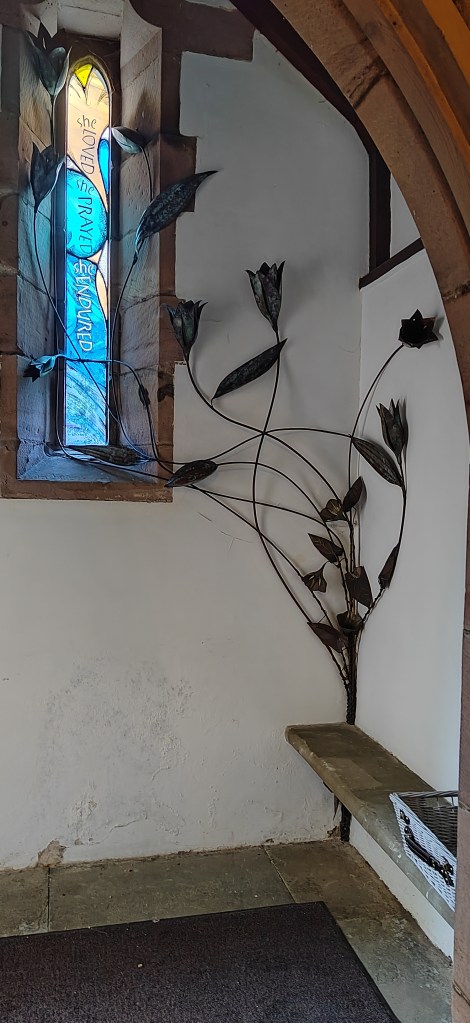
The artwork is made up of a stained-glass window and a sculpture which contains nine lilies arranged so that they appear to be growing around the light of the window. The artwork was created by artist Helen Whittaker in 2006 and has been permanently displayed as part of the fabric of the church itself since its installation. Helen Whittaker’s website describes the symbolism which has been designed into the work of art, stating that the way the stems are tangled represents “the social constraints of Josephine Butler’s time, as well as the emotional turmoil that Butler experienced as a result of the sudden death of her young daughter”. Whittaker goes on to link Butler with St Catherine of Siena and uses this as the basis for what is inscribed in the window itself – “She Loved; She Prayed; She Endured”.
The artwork itself stands tall within the vestibule and can not be missed as the building is entered however, its scale at almost nine feet tall means that it’s best viewed from slightly inside of the church door itself looking back out to the vestibule in order to see the artwork and stained-glass window as a cohesive whole. Josephine Butler is also buried in the churchyard here; her grave has an information plaque beside it and is around the back of the bell tower.

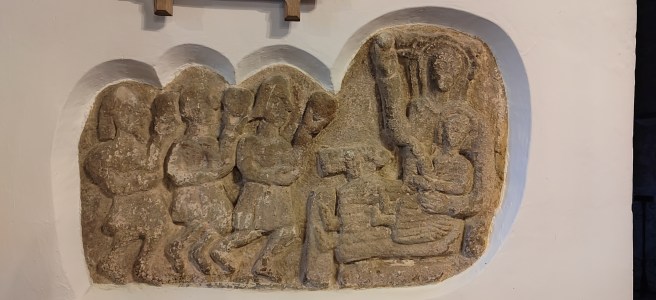
Inside the church, there is another very intriguing piece of artwork, the Adoration of the Magi. This carving is thought to date from as early as the twelfth century but could possibly be older if it was part of an older church on the same site. What makes this carving so interesting is that the magi are all wearing either kilts or tunics. Because kilts weren’t popularised until the late 1500s, it is highly likely that the depictions here are of the Magi wearing roman style tunics. An article on the Megalithic Portal brings forth the idea that “the style of the Magi is similar to an example in the Roman Catacombs, so there could be the influence of St. Paulinus, himself a Roman (who supposedly preached at Kirknewton)”. If this is the case, then this carving would be a direct product of the Anglo-Saxon kingdom of Bernicia – which later merged with Deira to create Northumbria.
The idea that Paulinus may have preached in what is now such an out-of-the-way location isn’t too difficult to imagine. He had been sent to Kent from Rome, and after 625 AD he became a Bishop and was in fact the first Bishop of York. Paulinus was known to have travelled Northumbria (Deira and Bernicia as they were then), so it isn’t unlikely that he would have stopped for time at one of the Royal Palaces which existed in Northern Northumberland at the time which was called Ad Gefrin (Near the Hill of the Goats), which is only half a mile from where Kirknewton now stands, though its thought a church once stood within the old palace complex. Much more may soon be known about the royal palace there a there is a current archaeological dig taking place.
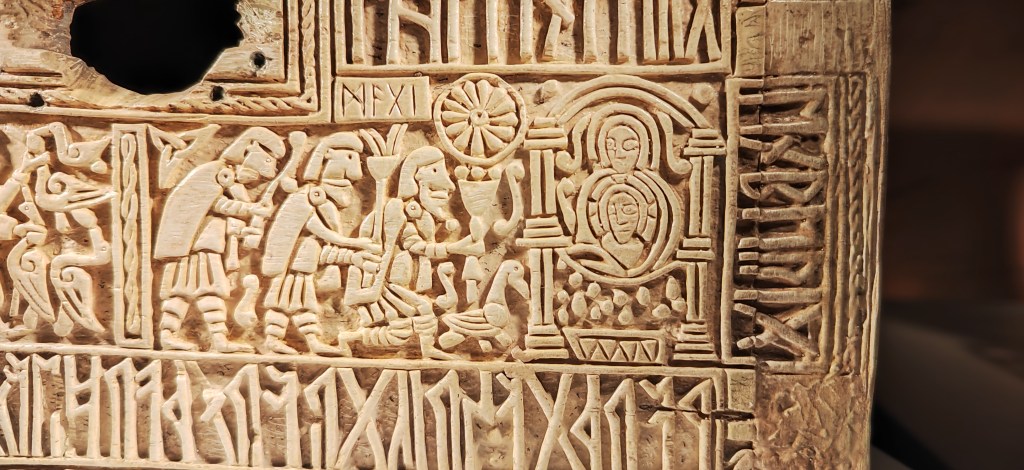
The carving in the church at Kirknewton also contains a huge similarity with a carving of the magi on the right-hand side of the front of the Franks Casket. The Frank’s Casket is a small box, maybe a reliquary which was produced from the bones of a beached whale in approximately the seventh or eighth centuries in Northumbria. The origin of the whalebones used is actually noted in the runes on the front of the casket. A replica of the casket can be found in the small museum which has recently opened inside the new Ad Gefrin distillery in Wooler.
If you have enjoyed reading this blog, why not help support my work by buying me a coffee. https://www.buymeacoffee.com/aislingonart
References
https://www.english-heritage.org.uk/visit/blue-plaques/butler-josephine-butler/
https://www.helenwhittakerart.com/portfolio/st-gregorys-church-kirknewton/
https://www.megalithic.co.uk/article.php?sid=47244
https://co-curate.ncl.ac.uk/resources/view/78852/
https://artsandculture.google.com/asset/the-franks-casket/qgGG57GxhdpqBw

 Aisling on Art