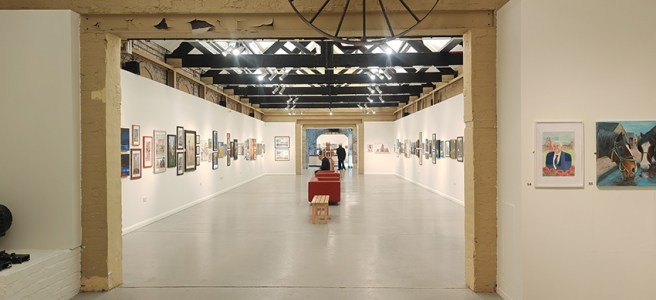
Northumberland Open Exhibition – Woodhorn Museum
Annual museum ticket £9.50 adult / £8.50 concession.
The Northumberland Open Exhibition is an annual event at the Woodhorn Museum, in Ashington. The exhibition organisers set a different theme each year, this year it is ‘Northumberland Now’, and artists were invited to submit works for inclusion within the exhibition. As always for this exhibition, the standard of artwork on display is exceptionally high and remarkably varied. The exhibition combines quite a large range of work which utilises many different media including oil, acrylic, watercolour, textile, glass, sculpture, and others into a single coherent exhibition which is an absolute delight to walk around.
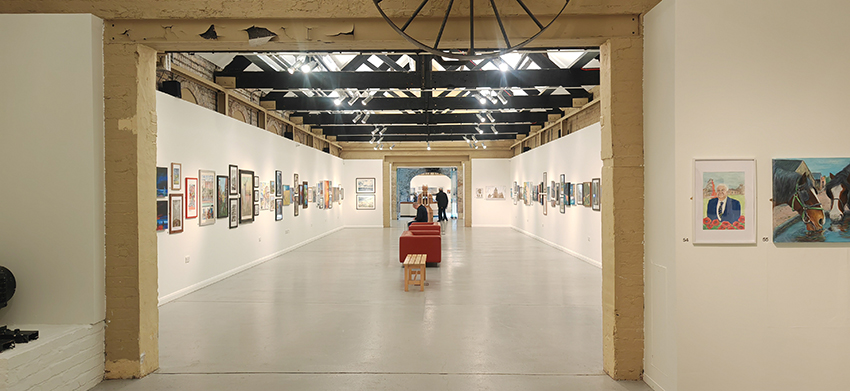
Museums Northumberland have placed this year’s exhibition at the head of a yearlong celebration to mark the 90th anniversary of the Ashington Group (pitmen painters). Throughout the year there will be a series of events celebrating the Ashington Group and their continued impact on the arts and culture of Ashington today. The next major event in the celebration is an exhibition of work by Oliver Kilbourne (1904-93) which also includes a conserved colliery banner.
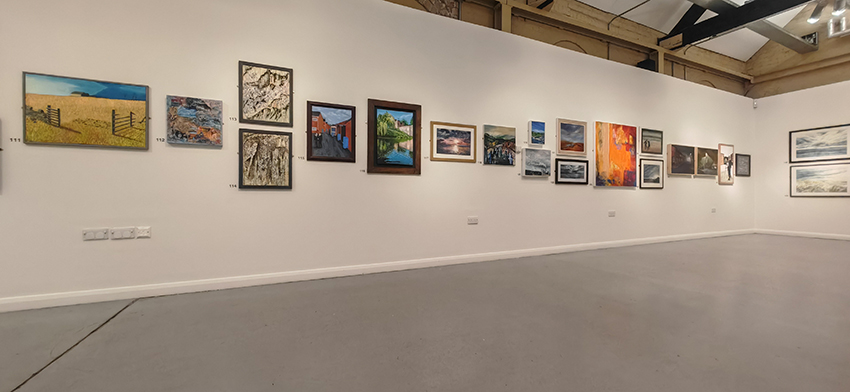
When I arrived at the exhibition, the gallery assistant who greeted me was extremely pleasant, knowledgeable, and informative, she really made for a great first few moments in the gallery as she explained the concept of the exhibition and pointed out the winning artwork. I was soon in the gallery however exploring the wonderful art for myself. After looking around the exhibition space, I even chose a favourite piece of artwork from among the amazing selection of work on display, though it wasn’t easy to choose a favourite piece.

The overall winner of the exhibition, as selected by the organisers this year is a curious choice! It’s a photograph! It isn’t often that a photograph comes anywhere close to winning an art exhibition at all, so this was a real surprise. The winning artwork, a photograph by Jim Donnelly is called “Northumberland Flood Plain – Autumn 2023”. His photograph depicts a very definite ‘now’ as a record of the excessive rain and flooding which Northumberland has endured within the latter half of 2023 and continuing on into this year! It is a nicely balanced and composed photograph. The composition contains a strong line, drawing the eye along a raised embankment through the floodwaters to the distance and the rain clouds within that distance. This ties together all of the different elements of the scene into a single cohesive view. Altogether, this is a very well-crafted piece of work.
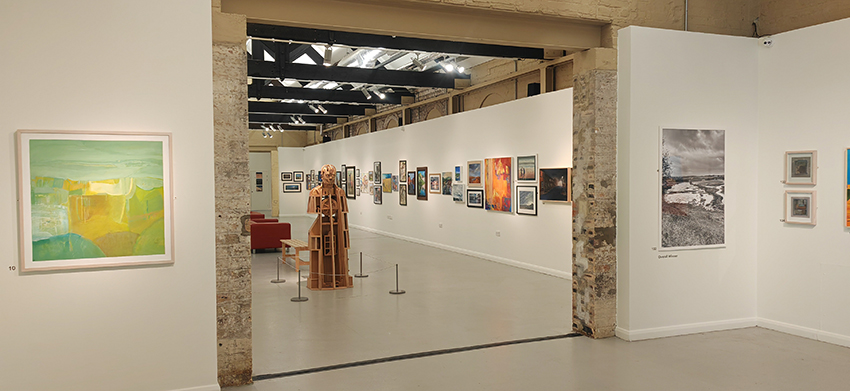
These are my top ten favourite pieces from this exhibition!
As I walked around the gallery space, I selected several pieces that I really liked and found engaging. The artworks which I have highlighted here are my personal top ten from this wonderful exhibition. I selected ten as this is an exhibition of well over two hundred works, any more would be impractical for inclusion within a blog, any less and I feel I would be leaving out some favourites which I think should be given a spotlight. The artworks I like are ranged across quite a broad spectrum of differing styles and techniques.
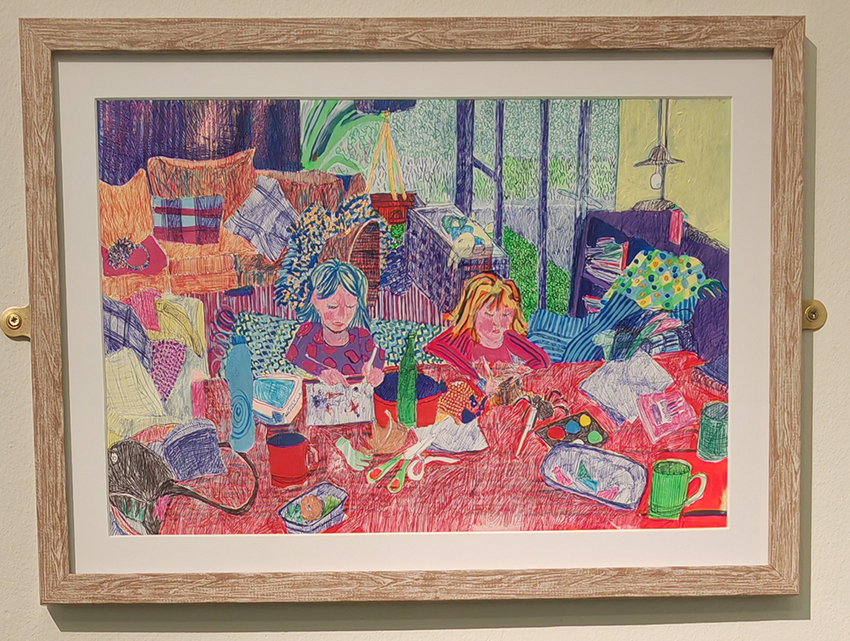
Tenth for me is Helen Bradley’s ‘Painting at the Kitchen Table’, created using Pastels and Ballpoint pen. I quite like the idea of people sitting around together creating something, it feels quite cosy. This idea of slow collaborative creation is something fast becoming lost to modern society. This work has a cosy, homely feeling to it with comfort and individuality expressed through the clutter of objects not only on the table but also in the surrounding room. When I first saw this artwork, and the one below, I initially thought that it looked similar in composition to one of Grayson Perry’s tapestries from his “Vanity of Small Things” exhibition, but on a much smaller scale. While this picture doesn’t have the same purposeful and overt symbolism, it does however convey a powerful sense of togetherness and camaraderie as the two people in the artwork just spend time together.
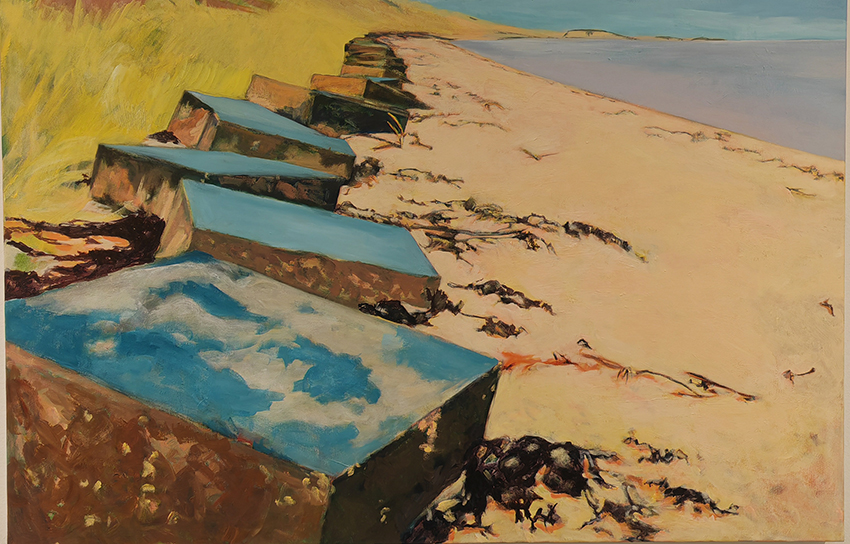
My personal ninth is Anita Brian Tyrrell’s work ‘Druridge’, which she has created from acrylic on Canvas. This painting has a quite interesting composition – the old concrete block anti-tank defences sit in a nice line, leading the eye from the bottom corner of the artwork through the middle distance of the picture space to a point where they blend together with the sand dunes below the sky. This gives the eye a feature to rest on and the ability to judge scale. This leads to the revelation that this beach is a lot bigger than a short glance suggests it to be. Those blocks also seem to take on the appearance of a demarcation between seashore and land, surrounded as they are by seaweed, they are a final line of protection now for those dunes from the advancing sea. I quite like the use of a minimal quantity of sky in the scene as this opens out the picture, giving it a nice balance.

My eighth is Len Smith and his artwork ‘Friends of Furnace Bank’, painted in oil on canvas. There is a good sense of community and selflessness in action in this charming scene where a group of what I would assume are volunteers are clearing away litter. Most likely it was left behind by careless and untidy intruders into their space and community. Those picking up the litter look as though they are part of an established group of friends who do this regularly. It’s extremely saddening that more and more people are dropping litter into the landscape now than have done before in the past. This painting is a great critique of modern society and how within it there is always someone picking up after the careless actions of other people.
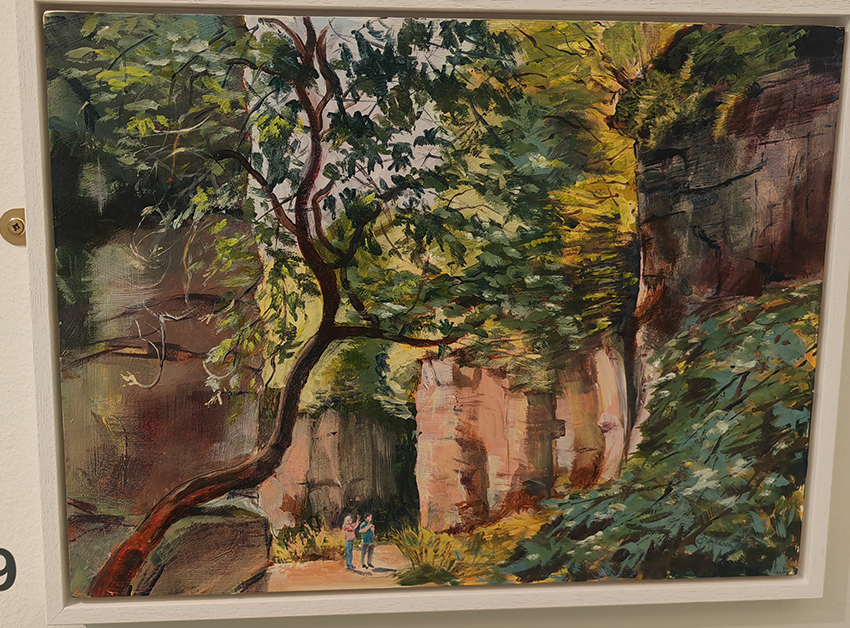
Seventh is Cynthia Davidson’s painting, ‘The Quarry Garden I’, made with acrylic on a wood panel. This piece appeals to me because it’s a place that I am quite familiar with and which I have visited on many occasions over the years. I adore how the artist has used the negative space of the rock faces on both sides of the picture space to frame the inside of the quarry garden. The couple which she has included stood in the centre of the quarry are ideally placed to demonstrate the scale of the faces of quarry walls surrounding them. The overly large cliffs give an excellent sense of seclusion to the space, this is only emphasised by the tree at one side of the painting and the bush at the other side. The open space in which the couple stands, like actors in a theatre, is a great counterpart to the enclosed feeling that comes from being between those cliffs.
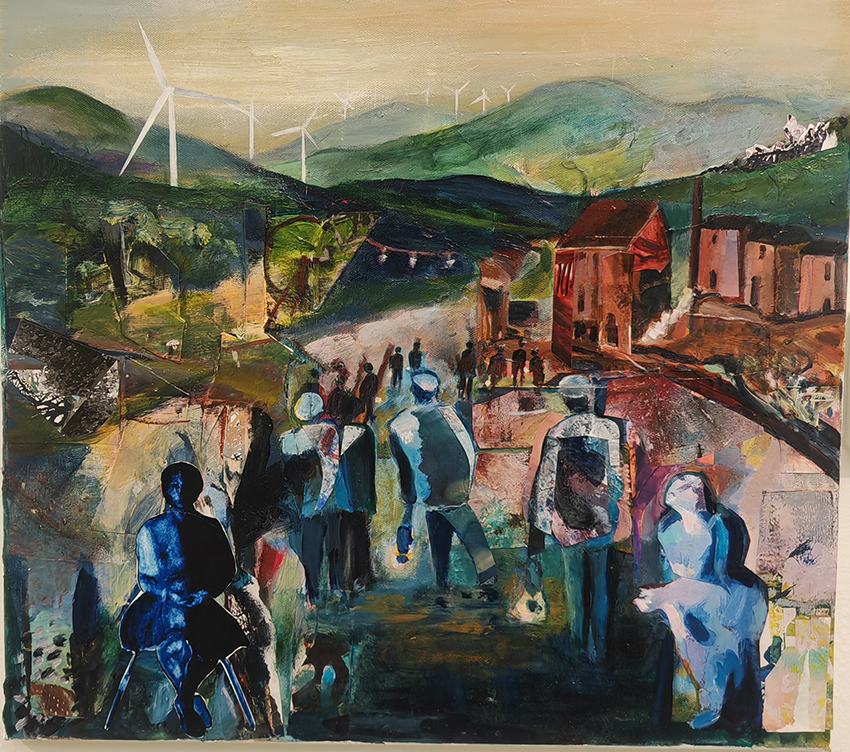
For my personal sixth I chose Judy Seymore’s ‘Now and Then’, this colourful mixed media piece has packed a lot of imagery into a relatively small artwork. This picture demonstrates a progression from the old to the new in terms of power. In this scene, the industrial past is at the bottom of the image and shows the workers going out to work in the mines. This is now largely seen as a thing of the past, though it is thoroughly engrained into the very fabric of the regional psyche. The buildings in the middle are a darkish red, as though covered in the dust, dirt and grime that result from the industrial processes that take place inside them. It is almost as though the space outside of those buildings was seen as not relevant or worth taking care of by the businesses inside. The top portion of the painting ostensibly shows a new green culture which is supported by environmentally friendly power; however, this fails to engage with the direct destruction and habitat loss which is caused when putting the windmills into the countryside in the first place. Altogether, I think that this artwork is a marvellous concept, bringing together a range of differing elements into a cohesive and challenging whole and the resultant image just works.
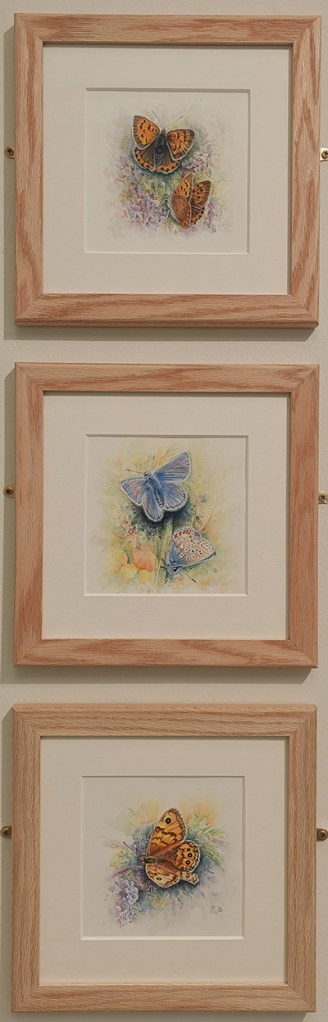
My fifth favourite in this exhibition is actually three different entries by the same artist which are all displayed together within the gallery. Brenda Barker’s ‘Small Copper, Common Blue’ and ‘Wall Brown’, all of which are beautifully executed in watercolour. This little trio of paintings are absolutely delightful, the butterflies extremely detailed, yet the backgrounds appear to have been done in a much looser wash giving the effect of a quite real-looking creature trapped in an insubstantial and ethereal realm. The reason for my selecting the trio as a whole was that I think they strike me as a body of work which belongs together, rather than each picture standing alone.
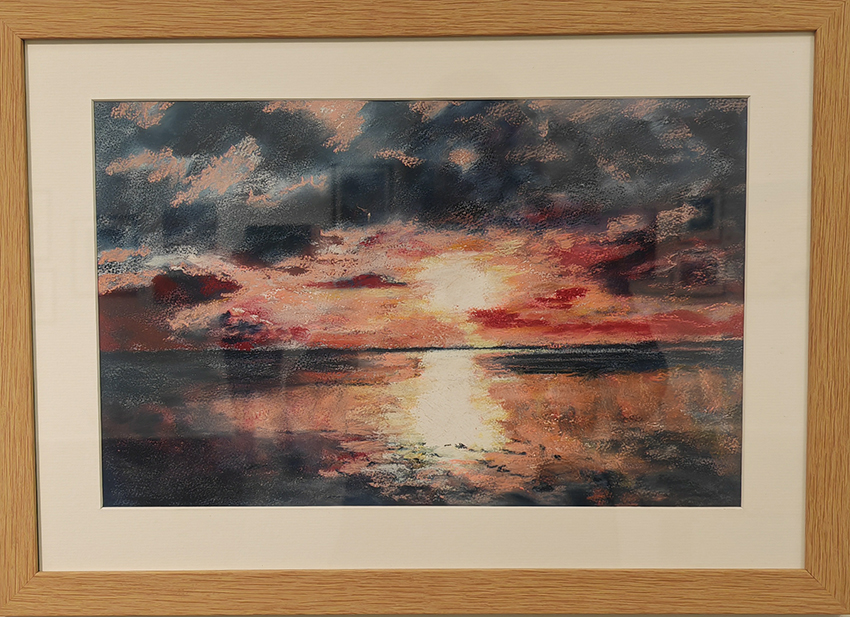
My fourth favourite of the exhibition is Janice Mack’s lovely ‘Cresswell Sunrise’, which she has created through a brilliant use of pastel and charcoal. This blend of different mediums creates a fantastic mix of subtle light colours, effects, and deep darkness, giving the artist the ability to really play around with the light in a way that wouldn’t be possible with other mediums. I was particularly drawn to this artwork because I really liked the subtle blend of colours within the clouds in the sky. The ruddy red and the grey are especially vibrant. The brightness of the sun, just as in nature is quite overpowering on the seawater. This effect combined with the low horizon creates a substantial feeling of openness, excitement, and warmth within the picture. The whole composition, surrounded almost by the slowly retreating darkness is very engaging indeed.
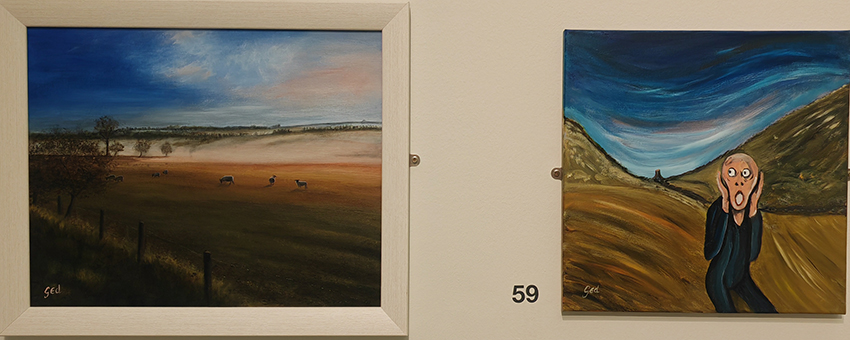
I really liked these two pictures which is why I decided that they should be my third favourite of this exhibition. Both of these pictures manage to show a completely different image of Northumberland as it is ‘now’ in two completely different yet complementary styles. These are both by Ged Livingstone, ‘The Lee Sidings Hay Field’ and ‘Sycamore Gap (Sans Sycamore)’, both painted in acrylic. The first of these images shows a sleepy rural scene, one typical of Northumberland with sheep grazing idly in a field. The lighting on the clouds and mist hint at this scene being early in the morning. The different areas of the painting blend together through a gradual difference in tonality, leading the eye out from the darkness into the light. The other artwork however could not be a more different scene, the sense of tranquillity that should be associated with the location pictured has been savagely snatched away, the peace shattered. The man in the impressionist style depiction of Sycamore Gap is standing in the same pose as; and looks similar to that in Edward Munch’s ‘Scream’. The act of a scream here could be symbolic of many things, like the ending of a life, or the desecration of a cultural icon that is deeply rooted within the collective conscience of the area’s unique culture. This painting is very apt for the moment in Northumberland’s story.
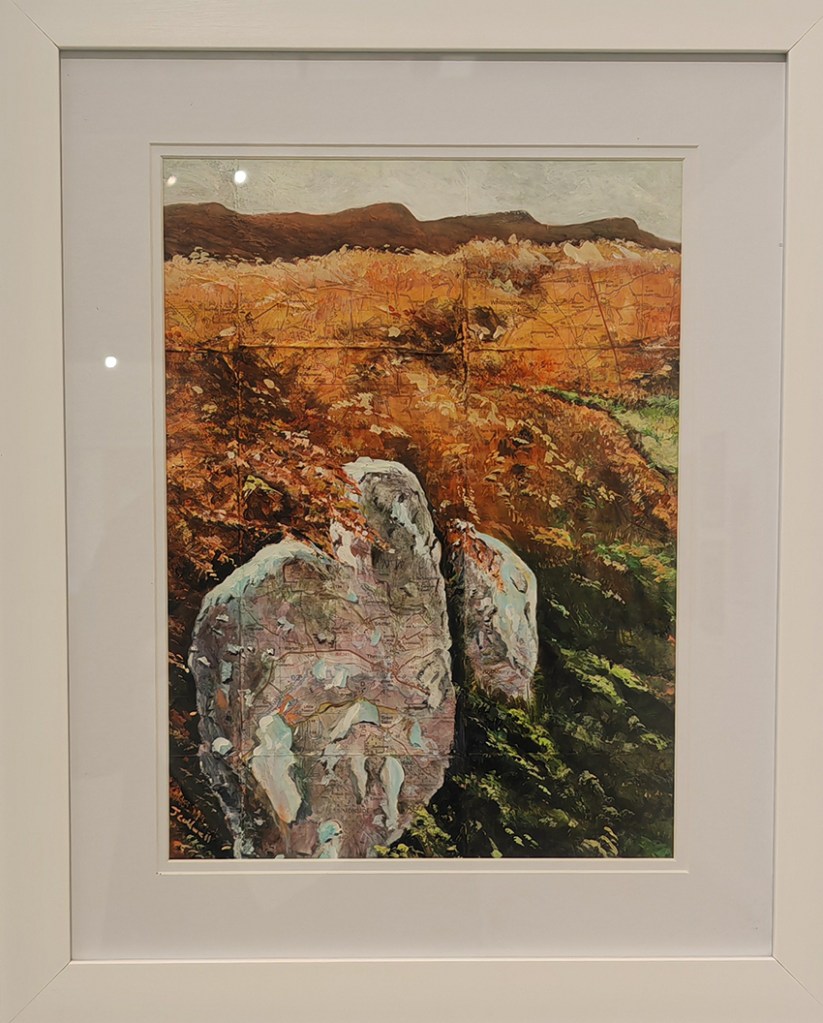
My choice as my second favourite is a painting that really speaks to me. Its subject – ancient stones – is something that I take a personal interest in, and I regularly go to visit collections of them. Jean Coldwell’s fabulous artwork ‘Golden Garliemoor, Timeless Stones, Same Then as Now’ is a charming painting which has been executed on the surface of an ordnance survey map. Having parts of the map visible through some of the paint is a nice way to reinforce that these stones make up a part of the landscape and that it wouldn’t be the same without them. The stones themselves dominate the foreground of the painting; they occupy a landscape which looks as though it may become overgrown at some point in the near future. The encroaching vegetation blocks out the view of any more landscape save for the hills at the very top of the picture space. The composition of the picture forces you to interact with the stones and to wonder for what purpose they were placed within this landscape.
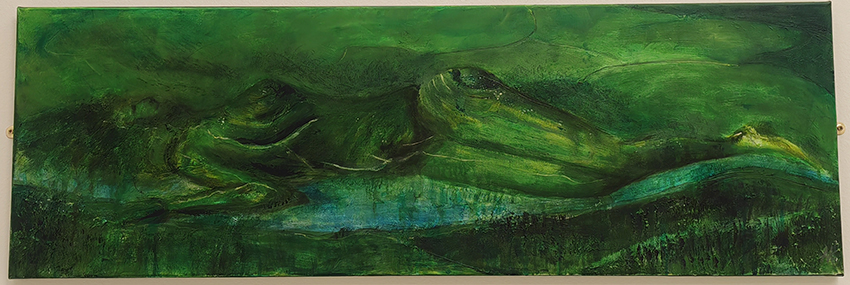
My overall favourite artwork from this exhibition is Annie Kennerley’s absolutely beautiful work ‘The Lady of Northumberlandia’ which she has created through a combination of Mixed Media, Acrylic and Ink. Northumberlandia as imagined here is less of an abstract concept and earthwork construction, but instead, she is shown as a woman, or perhaps a giantess slumbering within the landscape, she becomes a giant sleeping goddess rather than an earthwork project. Looking at Annie’s artwork it appears true to the shape of the earthwork that she has engaged with. Taking on the profile of the artwork Northumberlandia as viewed from the south, with her looking as she would within the wider landscape itself. I absolutely adore the green colour tones of this artwork, the monochrome image with a textured appearance really makes her stand out better than if this had been a more traditionally coloured picture. There isn’t really anything in the picture to hint at the scale of the sleeping woman, so if you didn’t know how large Northumberlandia was, you could be forgiven for thinking that this was just an ordinary-sized woman lying in the grass.
There were several major themes among the artwork at the exhibition this year, some of which aligned with current events, and some are just themes that people think of when they hear the county name of Northumberland. The artwork of the coastline, whether stylised or realistic is always there as the coast appears in every ‘now’ which Northumberland has existed. The two real standout themes though are the proliferation of wind turbines within the environment and the loss of the sycamore tree along Hadrian’s Wall. The artworks on display portray the wind turbines in both a positive and negative light, making fun of their placement, or lamenting a view destroyed by them. The artworks dealing with the tree however appear mainly ones that deal with the emotions of sadness and disbelief which have consistently pervaded the public space since it was violently torn down by vandals during a storm in the early part of autumn.
The exceptionally high quality of the artwork on display and the sheer range of art made it difficult to decide which I liked the most. The ones which I decided were the most engaging to myself are images and ideas that creep up in common local culture or mythology.
Links
Northumberland Museums https://museumsnorthumberland.org.uk/
Woodhorn museum https://museumsnorthumberland.org.uk/woodhorn-museum/
Open exhibition 2024 website https://museumsnorthumberland.org.uk/whats-on/northumberland-open-2024/
Upcoming exhibition at this museum https://museumsnorthumberland.org.uk/whats-on/oliver-kilbourn-my-life-as-a-pitman/

 Aisling on Art
I agree with a lot of youre choices but I havnt visited the exhibition so there maybe others I prefer. Your number “The Lady of Northumberlandia”, is one choice I agree with because its using art to portray art within a green era, mother nature, landscape and femininity. I noticed that most of this art work is concerned with the environment ! On “Now and Then”, could the red bricked buildings represent the Consett area from its recent past with the miners (or steel workers?) and the future wind farms located around this uniquely high altitude positioned town ?. But out of youre selection the “Sycamore Gap (Sans Sycamore)”, is the most thought provoking work of art I have seen for a long time. To some it may be amusing or sarcastic or as I felt looking at it, horror, anger and sadness ! An interesting blog thanks for sharing it !
LikeLike
Thank you very much for your well-considered response. It had never occurred to me that the red-coloured buildings could have been consett! I’m glad you felt my selection held a good range of thought-provoking pieces. I really would recommend going to view this exhibition, I just can’t do it justice here.
LikeLike