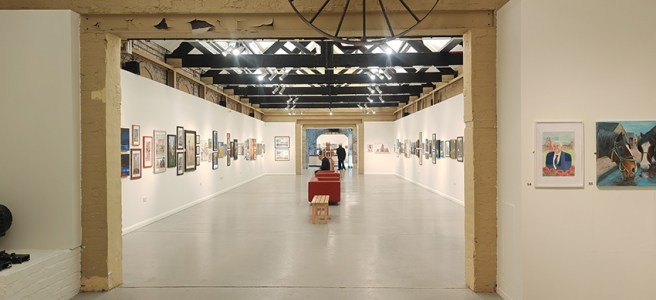
Woodhorn Museum, Ashington – Until May 6 2024. Annual ticket – £9.50 Adult / £8.50 Concession
On the night of the 27th – 28th September 2023, during storm Agnes – the first named autumn storm, disaster befell Sycamore Gap. The next morning the iconic sycamore tree was discovered to have gone over in the storm during the night. It didn’t take long for the news to be disseminated almost globally that this tree, one so famous it was known by sight almost right across the globe, had been felled during the night by vandals. Sadly, those who committed the act, though known to the authorities will never face the rightful justice they deserve for their desecration of the collective cultural memory.
This tree however wasn’t just a tree, it was a symbol of a place special to many people both locally and globally. Couples in love were engaged there, and the ashes of loved ones were scattered there. People even visit from other continents to walk the path, seeing the revered tree was seen as a rite of passage. A few years ago, in 2018, the tree had even been crowned as tree of the year. The tree was so endemic within local culture that barely a day went by without a photograph of it appearing in thousands of social media feeds. It was a spiritual place, a place of pilgrimage for many; the closest thing we had in Britain to a tree that was almost considered to contain its own spirituality within its iconic setting.
The theme of this article is how Northumbrian artists have responded to the loss of the iconic tree rather than lament, and what better source could I have for this art than the Northumberland open exhibition – Northumberland Now which is currently taking place at the Woodhorn Museum in Ashington, Northumberland. There were quite a few images of sycamore gap at the exhibition this year. I selected the five which I thought were interesting, or which conveyed a sense of emotion, or hope for the future within their art. There are few occurrences that have the power to impact the cultural psyche of an entire region like the vandalism of the sacred space in which this iconic tree sat.

There were three pieces that really took me by surprise, these were all different but similar versions of the sycamore tree which Anke Rainbow has created and submitted to this exhibition. I really adore these as a trio, they have all been crafted to be the same size and all are very similarly framed. Each of these images is also individual within itself. In the top artwork, ‘Grieving the heart of Northumberland’, the trunk of the tree is severed above a stump and a heart is held in place by wire in a cut out at the top of the tree. This work feels raw and emotional, like it was produced as a part of the huge outpouring of grief which immediately followed the news, of the tree’s untimely demise. The heart trapped within the copper wire could represent the artist’s personal grief, but simultaneously, the hearts of all of those not only in Northumberland but also globally who felt the same loss as we did here.
In her second picture, the tree is a rough and textured affair, darker in colour, almost the colours of autumn. The artist has created this striking image using found materials, things taken from around the tree when it was still in place. Her use of this found material, which is now irreplaceable as it was collected before the felling lends a hugely personal feeling to the tree. Her last picture of this trio ‘The Ghost of Sycamore’ has quite a surreal feel to it. The landscape is there as it should be, a constant against which the entire drama has been played out; however, this landscape contains only a stump, rendered here in colour to mark the portion of the tree which remains in situ. The ghost tree which sits above has attached to it metallic casts of the texture of the bark from the famous tree. This allows the tree therefore to live on in this image of its afterlife. This ghost of the tree has relevance as images of the tree have begun to haunt our social media feeds. Pictures of sycamore gap without the tree have a sense of sadness about them, while older pictures of the gap, which contain the tree have a feeling of loss attached to them these days. It may yet be a long time before this ghost is finally quietened in Northumberland.
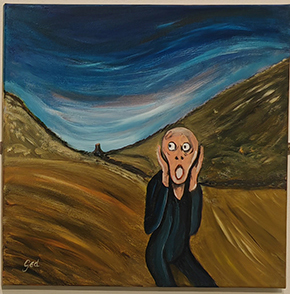
Artist Ged Livingstone has created this remarkable painting called ‘The Gap (Sans Sycamore)’ which perfectly displays the level of disbelief which was felt on that fateful September morning. The gap and tree stump have been executed here in an impressionist style with, the painting itself conveying a sense of motion or of change. The man in the foreground screaming is reminiscent of the solitary figure in Edward Munch’s Scream; this person’s scream in my opinion can be seen as representing the screams of an entire region; or perhaps an even wider community as the news came out that a hugely iconic symbol of not just our location was destroyed, but a part of the regional identity as a whole was forever stolen from us that night. In the artwork, the man is giving a sideways glance at the stump of the tree, which is all that remains, a look of shock in those eyes. Gazing towards the now empty space between the steeply undulating hills of the local landscape, we get the impression that one of the icons of our locality is now lost to us for eternity.
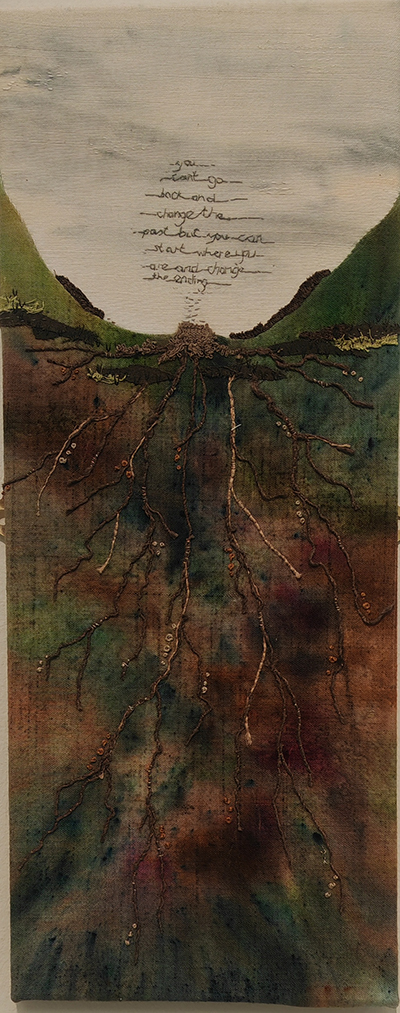
Individual artists have all chosen to engage with the space left behind by the sycamore tree in different ways. The submission to this exhibition by Jessica Kinnersley called ‘Roots’ is different to that of the other artists who are highlighting this place. It focuses on the underground space below as opposed to the overground which was utilised by other artists. Her textile art shows how the roots have spread far and wide deep underground, giving a clear image that most of the tree has not in fact gone anywhere, but that it is still alive and dormant. There is an epitaph which takes on the shape of the now vanished tree, sewn into the negative space between the hills stating that “You can’t change the past, but you can start where you are and change the future”. To me, this statement looks as though it is taking aim at all of the anger that was buzzing around after the callous action in September 2023 and that the artist is encouraging taking a step back and thinking about what action is to be taken as all actions have definite consequences. I like that this image has been substantially enough different from other entries to the Northumberland Open exhibition and that it really stands out as a genuine expression of the artist’s feelings.
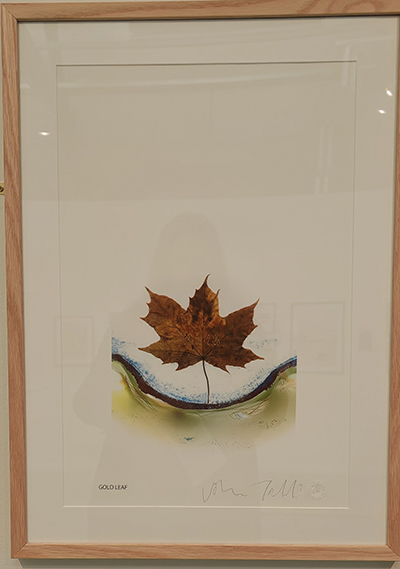
As time moves on though, so the cycle of healing and remembrance begins. One of John Todd’s submissions to the Northumberland Open exhibition is ‘Gold Leaf’, it is a limited edition print of a mixed media artwork in which the landscape of Sycamore Gap is featured, but with a real leaf taking the place of the tree. The leaf in fact at the drawn scale is larger than the tree would have appeared within this space, just like the memory of the tree has made the tree a larger feature in the collective mind than it previously was. The leaf has the date stamped onto it that the tree was violently brought down. For me personally, it is a combination of idealising the landscape and the dated brown leaf that makes this piece feel more like a memorial artwork for the sycamore tree rather than an expression of outrage or disbelief which is what has been clear and evident in other works. This is quite a lovely print which offers the viewer a sense of hope and optimism for the future.
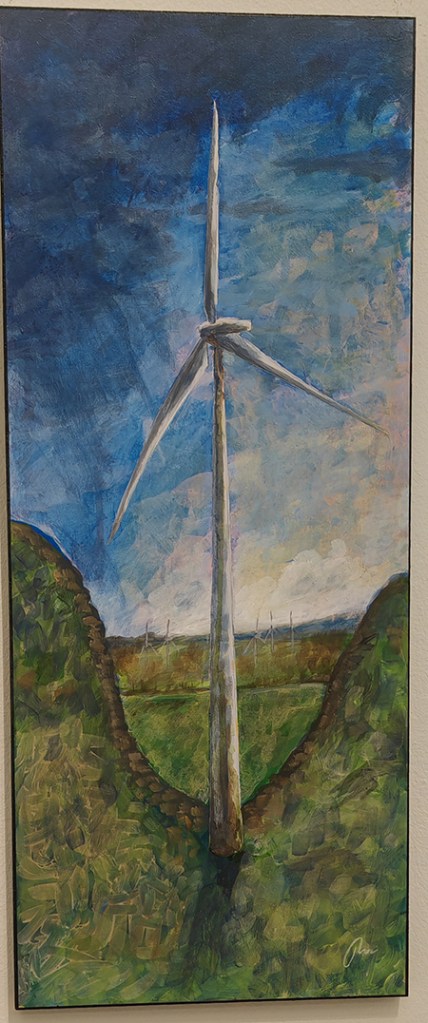
As time inexorably marched on, there have been more and more rumblings about how the space left behind by the tree should be utilised. Should it be left as it is? Should there be a new tree be planted? What about a nice little sculpture? The little dip in the hills that the sycamore inhabited created one of the best examples of photogenic framing and negative space that was accessible and viewable by the masses. John Tuff has played with this impression of framed space beautifully in his artwork ‘Windy Gap’. He has decided to play with the idea of placing a wind turbine into the space now unused by the tree. In doing so, he whimsically pokes fun at the attitudes that power companies seem to have towards the beauty spots in our country and the ruination of the environment that they bring about in the name of green energy and being environmentally friendly. This tall image is centred on the turbine, forcing it to the front of the space almost to the exclusion of the turbine-littered scenery behind
The concept of reusing a space that has an important social and historical history isn’t new, different spaces are reinvented regularly to create something modern, sleek or that may be visually appealing to a new generation of onlookers. The idea of repurposing this space as a place to put a wind turbine is wholly ridiculous and the artist knows that. However, when we look at some of the ridiculous suggestions of what to place in the gap, this suggestion is a little more visually appealing than some of the ideas put forth by the general public during the first weeks after the tree met its untimely demise.
It has now been almost six months since the loss of the iconic tree. The photographs of it that used to regularly appear on social media are being missed but have slowly been replaced by other images of the tree instead. Those who committed the deed are unlikely to ever face any real punishment; indeed, the whole thing seems to have been swept under the carpet and forgotten about by our local police force. The National Trust (who own the land that the tree was on) have the stump fenced off and have been working hard to grow a new tree from cuttings and seeds taken from the old. I personally think that the tree should be left alone to regrow from the root although, that will make for a less visually appealing tree and in the interim it may just look like a small bush for several years. I am personally glad that some of the more fanciful ideas for sculptures of the tree and other assorted things have all been consigned to the dustbin of history, they never would have fit the space properly. Artists and local businesses will likely keep the memory alive for as long as they can, in the meantime, Hadrian’s Wall is still as popular as ever for walkers.
Links
Woodhorn Museum https://museumsnorthumberland.org.uk/woodhorn-museum/
Anke Rainbow Art Jewellery – https://www.facebook.com/ankerainbowartjewellery
Jessica Kinnersley https://www.facebook.com/jkinnersleydesigns
John Todd https://www.facebook.com/johntoddartist

 Aisling on Art
A Fabulous but sad article ! You highlighted some fabulous works but the subject being the devastation of mother natures art and a global icon by the hands of lunatics ! I need to visit this exhibition !
LikeLike
I really would recommend going to see the exhibition. It really is the most beautiful collections of works.
LikeLike