7th November 2026 – 10th January 2027
£8.50 (day ticket); £16 (Annual ticket); Children Free
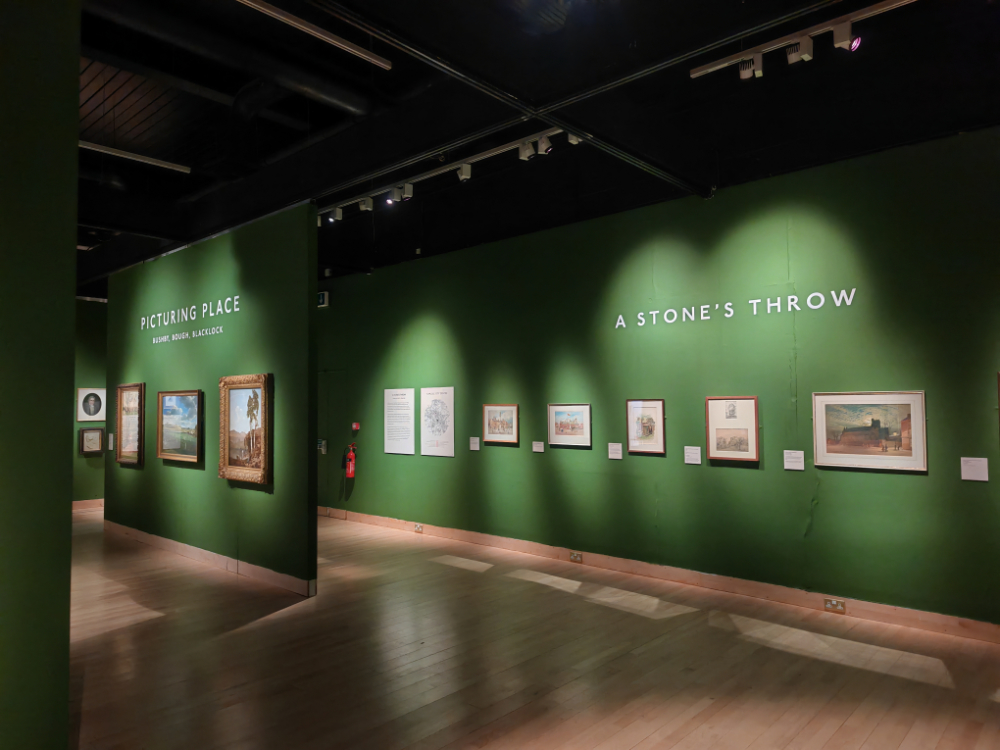
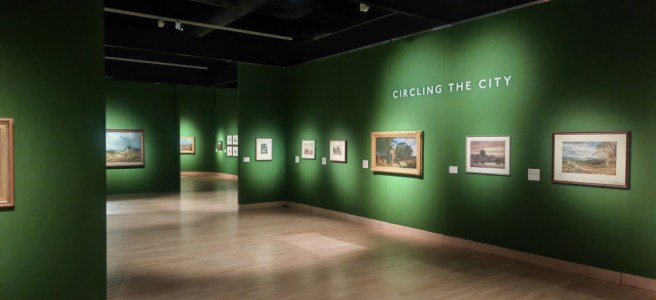
As we enter the gallery. We are greeted with a darkened green room with the exhibition inside; the hall is quiet, and the exhibition is still new. The lights are obviously kept at a low level so that the artworks aren’t adversely affected by the brightness. The exhibition is arranged thematically, with works by William Blacklock (1816 – 1858), Sam Bough (1822 – 1878), and Thomas Bushby (1861 – 1918) mixed throughout. The works of the three different artists, though they all have their own distinct characteristics, all work together in this exhibition, they complement and contrast each other’s skills most beautifully. There are a very small number of works by others, including Turner and Nutter, displayed within this exhibition also.
The exhibition opens with a good introduction to the artists and to their links to Carlisle and the locality, showing portraits of all three as well as a short introduction to each artist and their personal story.
While the majority of works in this exhibition are paintings, the curators have also included a decent number of sketches and preliminary, or unfinished works too. There are a couple of cases with artists’ personal artefacts, and sketch pads and things towards the end point of the exhibition. At the far point of the exhibition, there is a bench overlooking a beautifully painted picture of Grange, in Borrowdale, with leaflets and a couple of books artfully arranged there on the seat.
The thematic tone of the display leads us through scenes which are within Carlisle in the “A Stone’s Throw” section of the exhibition. There are images of the city centre, cathedral castle and the river bridges, all painted in beautiful detail. This is followed by “Circling the city”, where the views of Carlisle are from further away, as well as including local landmarks such as Dalston Hall. There are several artworks of places which are near to Carlisle, but without the city in sight, such as Wetheral and Bewcastle.
This section leads us into the ‘Call of the Wild’ theme where some of the most beautiful scenes in the local area have been showcased in all their glory. Some of these countryside scenes are rendered with brilliant precision; the mountains look the correct shape and proportions. This part of the exhibition even contains a few pictures created by Turner; Turner even thought well of Blacklock’s work.
Finishing the trip around the gallery space, we come to the “Unfinished business” section where there are works by all three of the artists in this exhibition, though in various states of progress from barely started to almost finished. As well as an assortment of sketches, sketchbooks, working rough copies and even a few artefacts which belonged to the artists themselves.
Here are a selection of works which are my favourites in this exhibition.
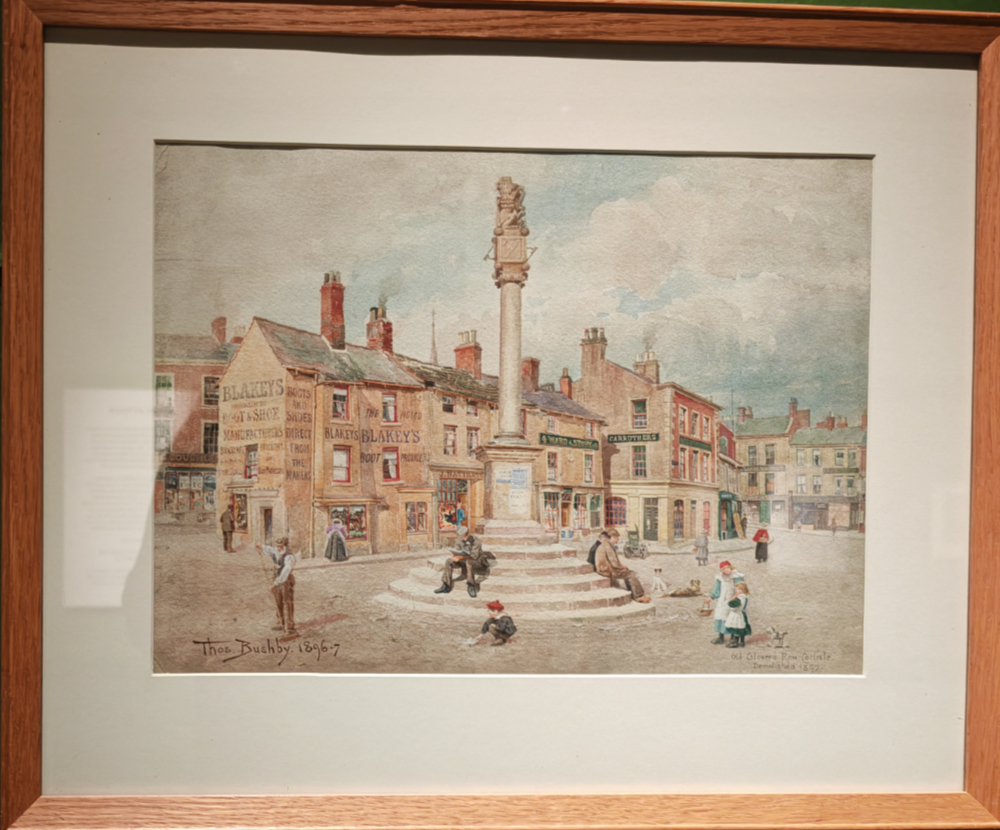
This is a beautiful little Carlisle street scene, showing people enjoying a bit of leisure time around the market cross, reading, chatting, and others going about their business. Behind them, though, is a row of houses which was demolished soon after. This picture clearly demonstrates the fashions of the day, with each person dressed quite individually. As well as showing off a great deal of the advertising which takes up most of the wall space on the end building, advertising for the boot maker whose shop is in there. This picture shows a tidy, clean, and orderly city with most of the trappings of modernity already in place.
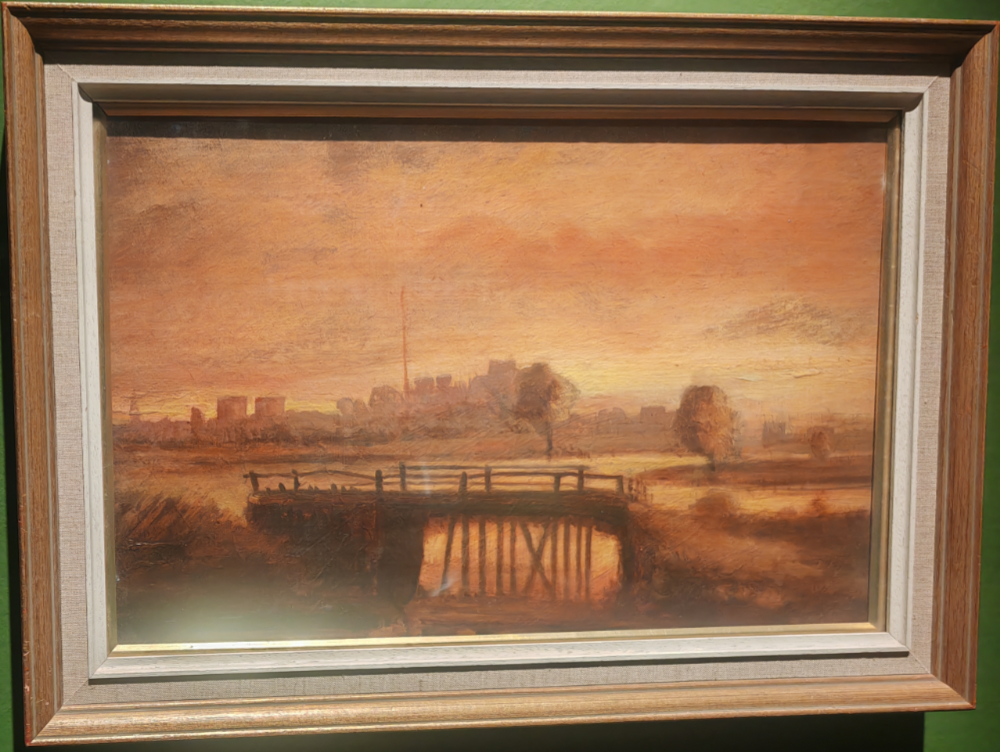
This beautiful, but red-tinged artwork feels as though it was painted of a riverside sunset somewhere close to the castle. The giant spire of the Dixon’s huge industrial chimney, which is still a prevalent part of the Carlisle skyline,/ is very much in evidence here, rising from what is an otherwise serene scene. The small, rustic-looking bridge and the bright sweep of the River add a lovely foreground scene, which in itself is picturesque; separated from the city proper by the flow of the Eden. The ruddy glow of the sunset light appears to add a layer of warmth over the city.
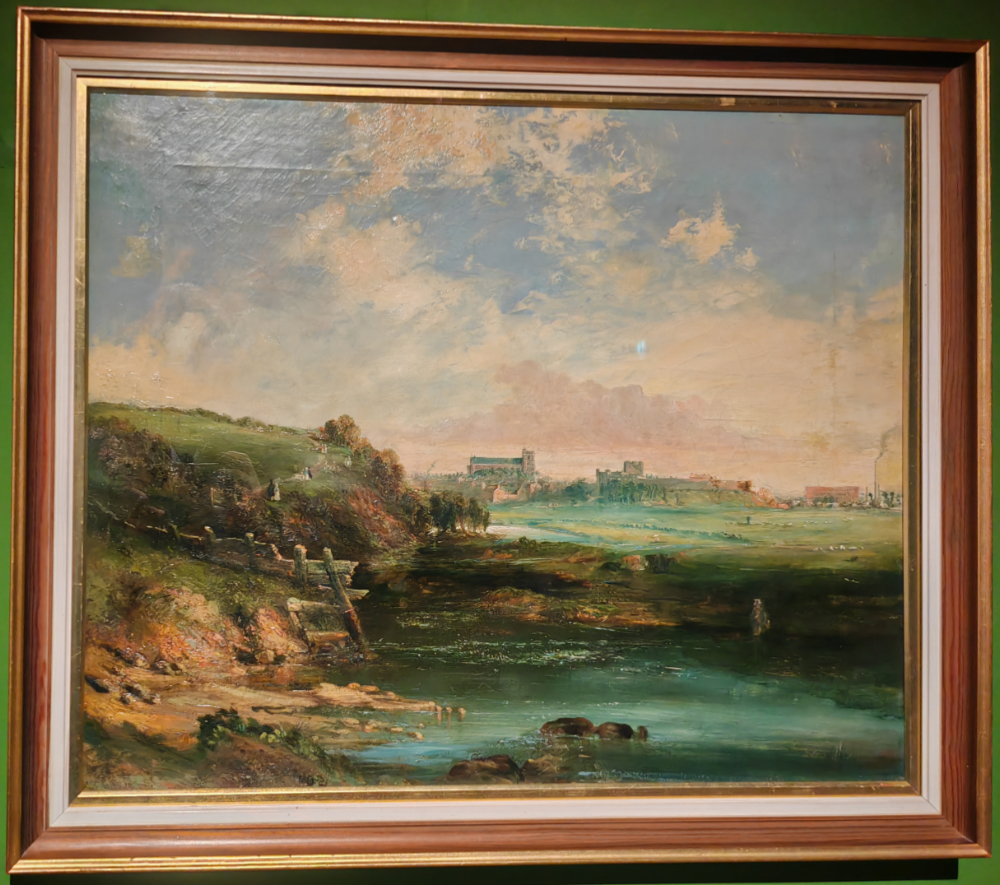
This beautiful oil painting shows Carlisle from the north bank of the River Eden, with the city partially hidden behind the foreground Hill. It would seem that a little artistic liberty has been taken with this painting, as it contains Queen Mary’s tower, which was demolished in 1835, as well as Dixon’s chimney, which was built in 1836. It also feels to me like the Cathedral and Castle are rendered closer together in this painting than they actually are, but that could just be an affectation of how I personally view Carlisle and the angle from which Bough has painted this scene.
The foreground is nicely detailed with rocks, water, a fence and even a man in the river fishing; however, the view of the city here is magnificent. The Cathedral and castle stand proudly over the city, almost as though the city has opted to cluster around those two buildings. The sky in this artwork is beautifully painted with some pastel pinks and blues in amongst the white of the clouds. The colours look naturalistic; this scene itself looks almost like you could just stroll into it.
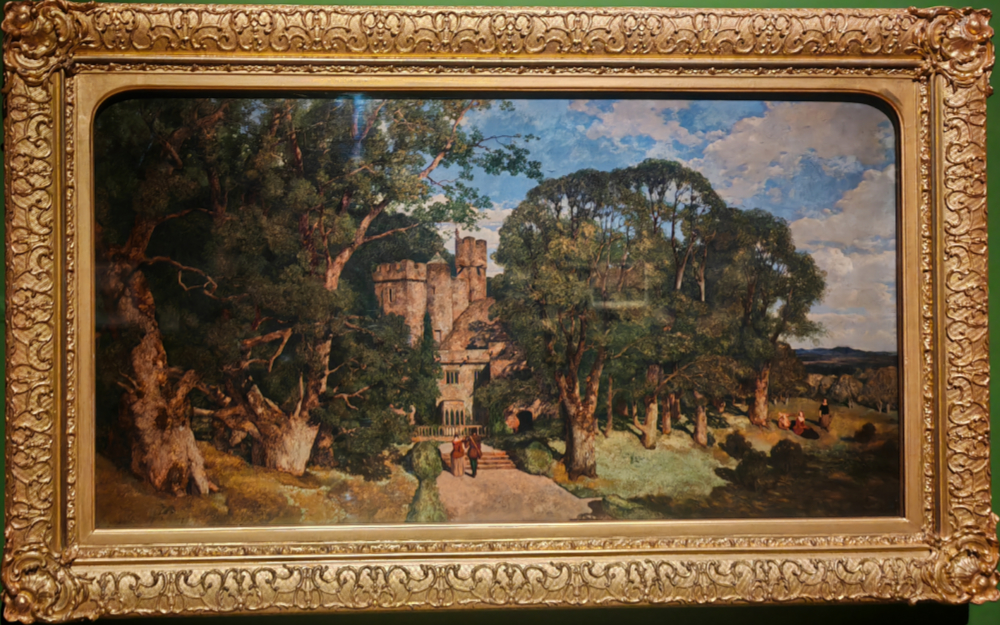
This beautiful painting, which contains the fantastic Dalston Hall to the south of Carlisle, is an absolute delight to look at. The building, sitting nestled in its cloak of trees, looks as though it began life as an old castle before being converted into a stately home. The masonry and trees are rendered with such beautiful precision and colour balance that everything here feels lifelike and to scale. The blues of the sky and differing greens of the leaves are all quite true colours to what is found in nature.
At first I thought the couple approaching the hall were the only people in the scene. Small as they are, they feel a little overwhelmed by the majesty of the scene in front of them; then I spotted the other triad of people on the far right, on a grassy bank in the sun. Two of them are relaxing, sitting on the grass; the third may be a servant of sorts, as she is standing to one side holding something and is dressed in an obviously poorer manner than the others. This idyllic country estate scene feels as though it could have been a Pre-Raphaelite artwork; it contains many of the same characteristics that their movement utilised, and a certain truth to nature
This painting was exhibited at royal academy 1854; so it would have hung alongside such paintings as The Marriage of Solomon and Aoife by Daniel Maclise, The Governess by Rebecca Solomon, The Awakening Conscience by William Holman Hunt among many other big names of the day.
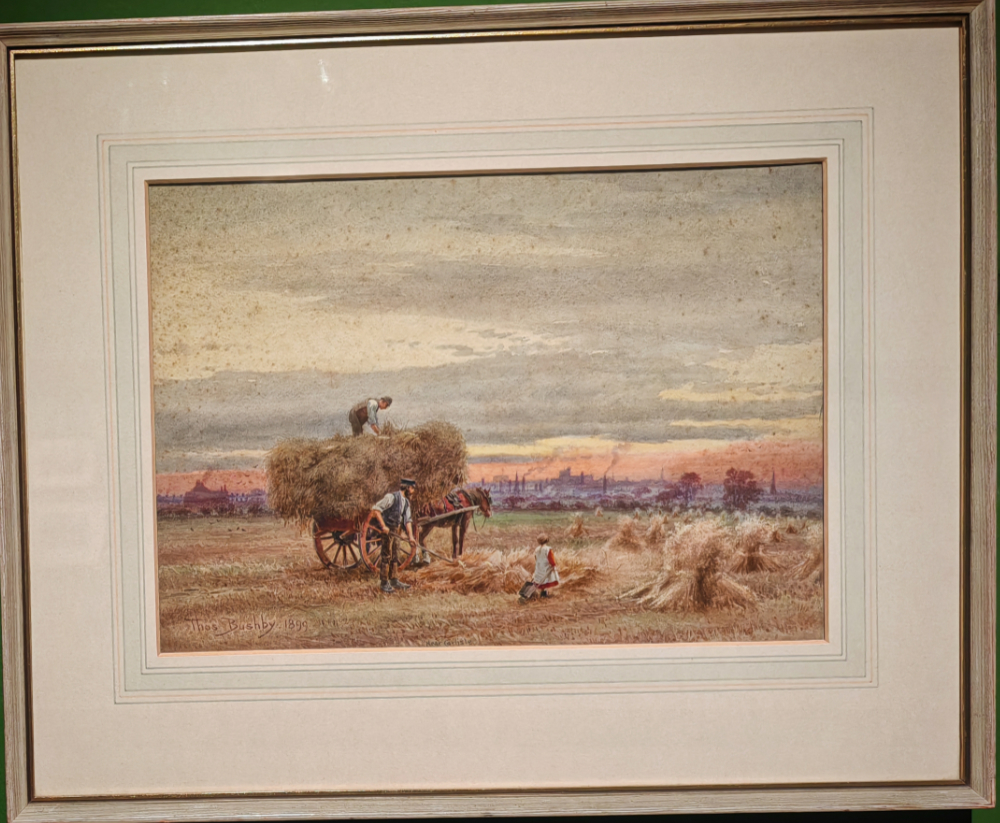
This beautiful watercolour shows an idyllic countryside pastoral scene and sets it against the distant backdrop if the city. Sadly, time hasn’t done any justice to this artwork, as it has some damage and spotting within the pictorial scene itself. In the foreground of this artwork, there are traditional stacked bushels of hay, cut and awaiting loading into the horse cart. A little girl with a small wheelbarrow is playing in the field close to the farmer, but is just out of the way of the work. However, this idyllic, pastoral foreground scene is interrupted by the inclusion of the darkened city beyond, with its densely packed buildings and smoking chimneys. The sunset in the picture feels as though it could e a metaphor for the sun setting on a particular way of life, as another kind of living, that of the city dweller, takes priority in society. The title of the painting is Last Load, so one has to wonder whether it is just the last load of this harvest, or whether it means that these fields are about to be swallowed up by a rapidly expanding late Victorian city.
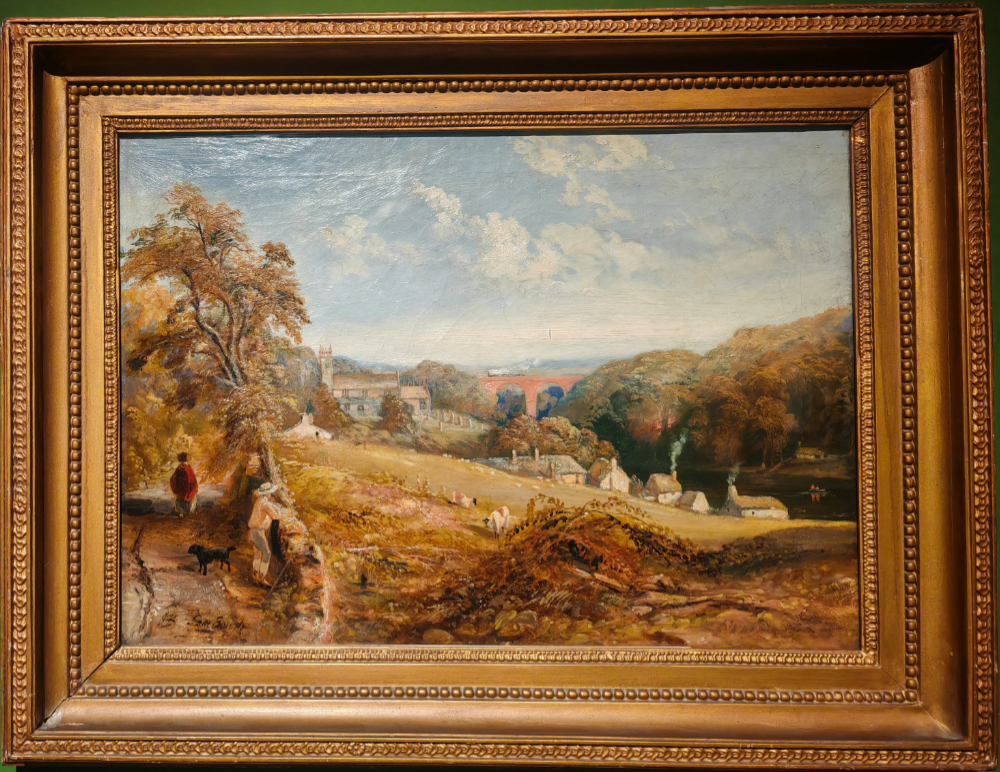
This magnificent depiction of Weatheral village, a few miles from Carlisle, is absolutely stunning. Painted in 1845, the viaduct taking the rail line over the Eden would still have been relatively new, as it was completed only eleven years prior. This becomes an important feature in the landscape as it blocks the view down and out of the valley from this particular vantage point. Bough has painted what feels to me like a beautiful autumnal scene, the sky a muted blue with clouds, the landscape itself containing a good amount of red and yellowy orange tones. The colouring of the stonework on the church and the lower buildings of the village matches quite nicely and shows a clearly steep hill towards the river.
The profile of the train crossing the viaduct is similar to very early steam engines like Stephenson’s Rocket. The church dominates the middle ground more prominently than the viaduct does slightly further back. I couldn’t help noticing a similarity between the profile of the church roof and that of the distant train. I love the inclusion of the two people in the boat on the river – perhaps a ferryman and passenger; I feel this really adds to the painting and generates a secondary sense of scale against which to judge proportions. They are nicely reflected in the still water of the river Eden. The near ground has a man looking over a wall, with a woman walking and a dog close by; I would have to judge that the man standing there is admiring the very same scene that we are within in this painting.
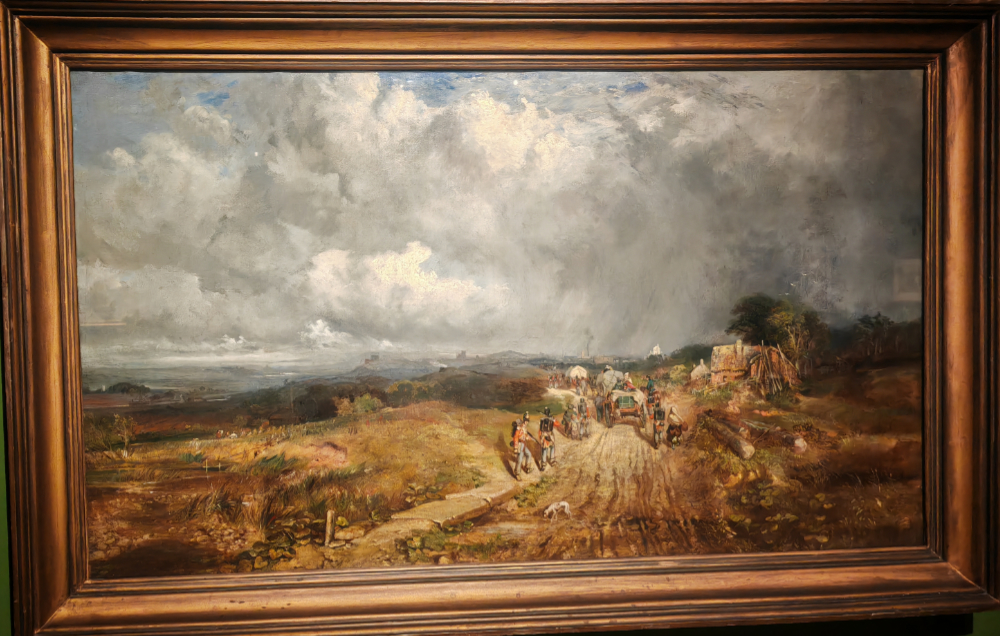
This is a large-scale painting, with what appears to be a military force approaching the city. The painting depicts the rear of the force; their baggage wagons, as they pass by they are piled high with stuff, even a lady riding atop the last one. It’s difficult to understand exactly whose viewpoint we are looking from; I don’t think we are a soldier’s viewpoint; perhaps we are an observer from the cottages, come to see the commotion. A soldier is looking back toward us as others walk on, following and alongside the moving wagon train. There are women and children moving within the group, but I’m not sure whether these are military families moving with the force, or whether these are refugees, or other people coming in from the countryside to carve out a life in the city.
The condition and paving of the road is poor, rutted as though from wheel ruts, wear and weather. However, the city is there in the middle distance, with a nice countryside scene on the left in the background. The column is headed right for the city. The weather in this painting is one of my favourite features: those dark clouds, the rain forming and falling over a part of the city in a quite foreboding manner; it looks to be either a very heavy shower or an approaching thunderstorm. This painting, in my opinion, is an absolute masterpiece of technique.
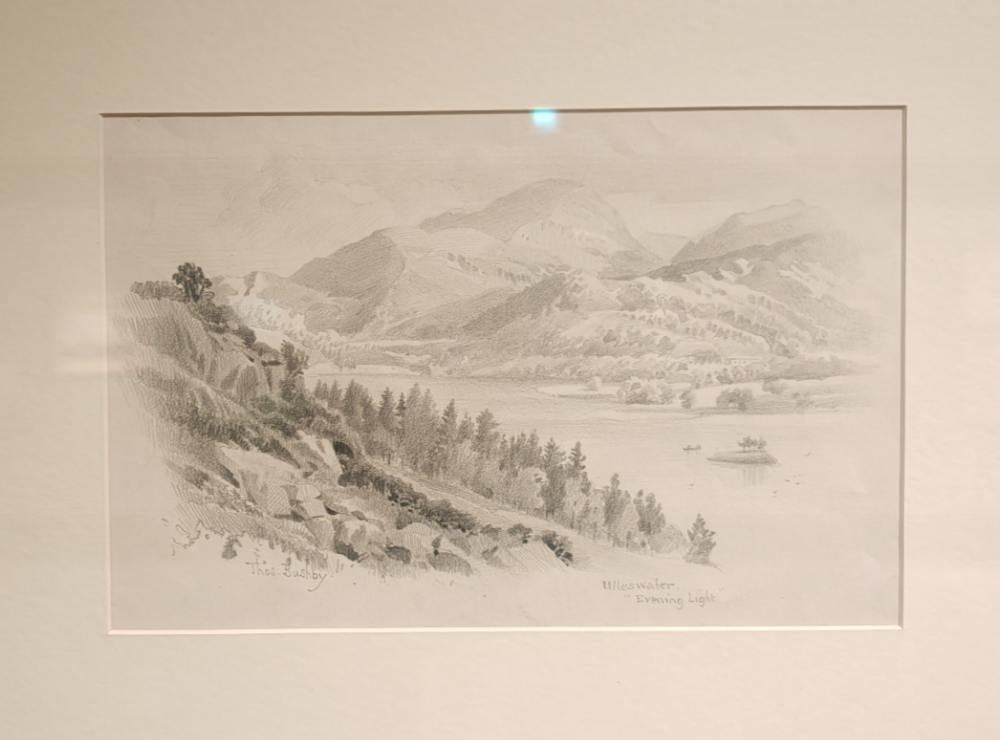
This is a delightful sketch of Ullswater; even though it is a sketch, you can clearly see where the light and shade fall across the mountains. The foreground detail and trees are beautifully drawn, with the small island, I think, may be Cherry Holm, with the view here towards Glenridding from the east. The island and the boat close by set a sense of scale within the image. The mountains across the lake are looming over the entire scene. Everything here in this sketch feels proportional and balanced; directional lighting has been taken into account, with sections of the mountain being thrown into shadow.
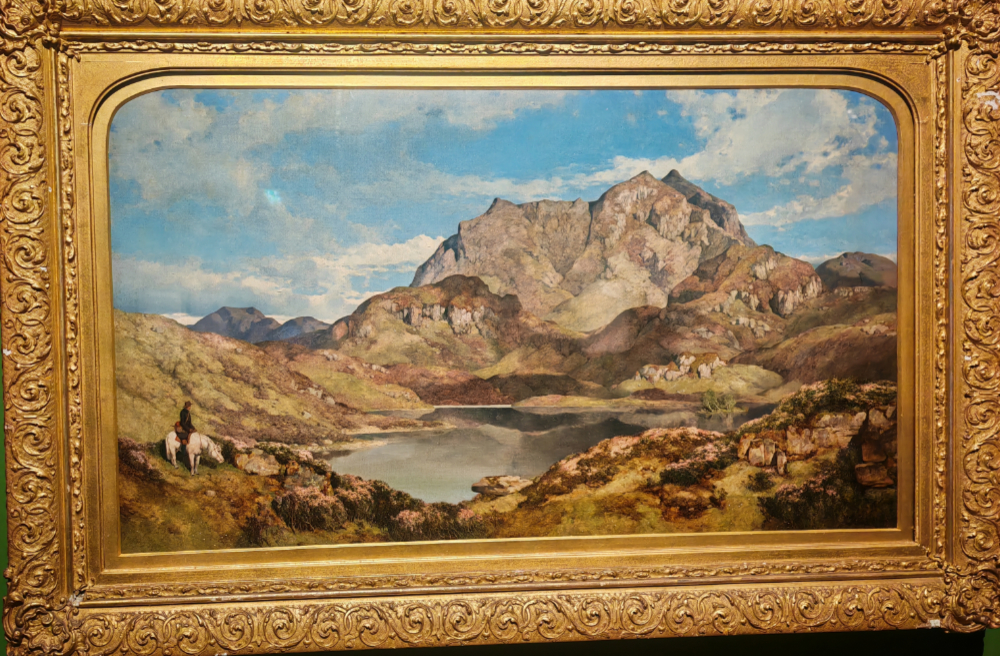
This painting by Blacklock is an absolute work of art; he has used the composition technique of the rule of thirds here, placing the far edge of the tarn almost on the third of the way up the painting line. Below this, we have the tarn, the foreground; the person stopped on the horse to admire the view; the island with trees in the tarn; they are sized perfectly to give a sense of picture space and recession into the scene. The mountains themselves even have reflections in the far water.
However, where this falls apart is the view above the far end of the tarn: Devock Water is a tarn which sits in a small depression in the moorland; it doesn’t really have a mountain looming over it as shown in this painting. The mountain in question is Harter Fell, which isn’t even shown from the same side as it would be seen near Devock Water. It is likely then that this painting was painted from several drawings which Blacklock had created while out in the countryside, and then assembled from parts of each of those drawings to get a really dramatic scene, much more dramatic than he would have seen.
Back in the mid-nineteenth century, when this painting was constructed, it would have been far less likely that anyone seeing the painting would have known of this discrepancy than it would be if an artist did that in our much more connected, visual-heavy, information-laden world in which we live. Unless a viewer was either from this very small area or had visited the tarn, it could go unnoticed.


